Maintenance and reliability engineering

Your maintenance plan, in days.
Every decision explained.

Applying RCM takes engineering hours that compete with day-to-day maintenance. ARC develops a plan tailored to your assets, with tasks linked to failure modes and documented decisions.

From 6–18 months to 1–2 weeks.
ARC's indicative turnaround, subject to scope, documentation and availability for validation.

Without the rationale,
risk remains implicit.

A failure mode goes unaddressed.

A plan can contain many tasks and still leave relevant failure modes untreated.

Longer intervals. What about risk?

Extending intervals or cutting tasks without making the consequences explicit makes the decision harder to defend.

The study ends. Execution never starts.

Without clear work packages, instructions and criteria, the plan still needs work before maintenance teams can use it.

ARC develops the study.
Your team validates it.

We apply RCM following SAE JA1011/JA1012, using advanced technology to organize documentation and develop the study. Your specialists review decisions and validate deliverables.

SHARED KNOWLEDGE

Built on the knowledge
of your operation.

Manuals, drawings, datasheets, maintenance history and internal procedures feed the Knowledge Base. This documentation provides context for studies across the ecosystem.

Infrastructure supporting all five products. Not sold as a separate product.

≈ 1h 30m

of processing to prepare a study for human review, in one case reported by ARC.

A study that leads
to execution.

Five products connect strategy development, comparison with the current plan, work order planning and maintenance interval review.

The study behind the plan

RCM GenAI

Operating context, functions, failures and maintenance tasks.

Traceable maintenance plan
Compare plans

Strategy
Comparison

What to retain, add or review against the current plan.

Plan execution

Work Order
Planner

Work orders with the client's instructions, resources and procedures.

Set the interval

Optimus
Maintenance

Intervals selected with total cost and risk understood.

Learn from maintenance history

Reliability Data Vault

Maintenance history converted into failure mode data.

The data supports

RCM GenAIAssessment of strategy effectiveness

Optimus MaintenanceCalibration of reliability curves

SUPPORTING ALL FIVE PRODUCTS

Knowledge Base

The client's manuals, drawings, specifications and procedures support the entire ecosystem.

Deliverables undergo human validation. Knowledge Base is shared infrastructure.
RCM GenAIDefine the maintenance plan

From operating context to task selection for each failure mode, following the RCM decision diagram. The plan groups deduplicated tasks into packages by interval and discipline, linking each task to its failure mechanism and function.

Explore traceability ↗
Strategy ComparisonIdentify what to retain, add and review

Compares every task in the proposed plan against the current or manufacturer's plan. Identifies shared coverage, gaps to address and candidates for removal, which require technical assessment before being discontinued.

Explore the comparison ↗
Work Order PlannerPrepare maintenance work orders

Converts work packages into task lists with adjustments, clearances, procedures and materials from the technical documentation. Incorporates the client's standards, including energy isolation, working at height and support resources.

Optimus MaintenanceSelect intervals with cost and risk understood

Assesses work packages using maintenance history and specialist knowledge. Shows the interval that minimizes total cost and the risk associated with a change, including the effect of grouping tasks.

Explore the result ↗
Reliability Data VaultTurn maintenance history into failure data

Organizes maintenance history to derive failure mode occurrence rates systematically and at scale. Uses the client's internal taxonomy or international standards. The data calibrates Optimus and supports the assessment of strategy effectiveness in RCM.

Your team's role:
make informed decisions.

Scope and available documentation define the starting point. Specialist involvement is focused on validation.

  1. 01

    Define the scope

    Agree on assets, operating context, issues with the current plan and deliverables.

    ARC + client
  2. 02

    Organize the references

    Gather documentation, maintenance history and internal standards to support the analysis.

    Client provides · ARC organizes
  3. 03

    Develop and validate

    Review functions, failures and tasks. Approve, adjust or reject with a documented rationale.

    ARC develops · client validates
  4. 04

    Deliver for implementation

    Finalize the plan and the additional services agreed in the scope.

    ARC delivers · client implements

Indicative delivery: 1–2 weeks, subject to scope, available documentation and the validation schedule.

Four criteria for
a defensible plan.

The deliverable must explain why each task exists, what changes from today's plan and which references support each decision.

Traceable
From task to failure mode and function. Includes the decision to run to failure when that is the selected policy.
Follow the chain ↗
Comparable
The proposed plan alongside the current or manufacturer's plan, with points of agreement and disagreement identified.
See what changes ↗
Asset-specific
Context, components, failure mechanisms and tasks linked to the client's equipment documentation.
Read a real task ↗
Auditable
Functions, consequences, applicability, effectiveness and intervals, each with a documented rationale.
Examine the decision ↗
RCM GENAI / REAL CASE

The path to the task.

Two excerpts from the product database, summarized and anonymized. An editorial presentation of the records, not interface screenshots.

Function
Enable operational travel while keeping the travel gearbox temperature at or below 80 °C.
Functional failure
Movement is maintained, but the gearbox temperature exceeds 80 °C.
Failure mode
External fins of the hydraulic oil cooler obstructed by dust and particles, restricting airflow.
Effect
Rising temperature, loss of oil viscosity and seal degradation, leading to an interruption of operation.
Consequence
Recorded classification: safety. Overheating may cause hose rupture, hot fluid release and fire.
Evident failure YesAffects safety YesDetectable condition YesOn-condition maintenance
SELECTED TASK
“Inspect the hydraulic oil cooler core fins for dust and particulate buildup, and clean if deposits restrict airflow.”
Applicability
The obstruction develops progressively and can be identified visually before functional failure, allowing intervention.
Effectiveness and economic assessment
The record considers the task viable: lower material, service and lost-production costs, with similar labor requirements. This is a qualitative assessment, without a calculated savings percentage.
Summarized decision paths. Identifying information omitted; task descriptions translated from the original records. These excerpts do not replace the full analysis or its technical review.

STRATEGY COMPARISON / REAL CASE

What changes from today's plan?

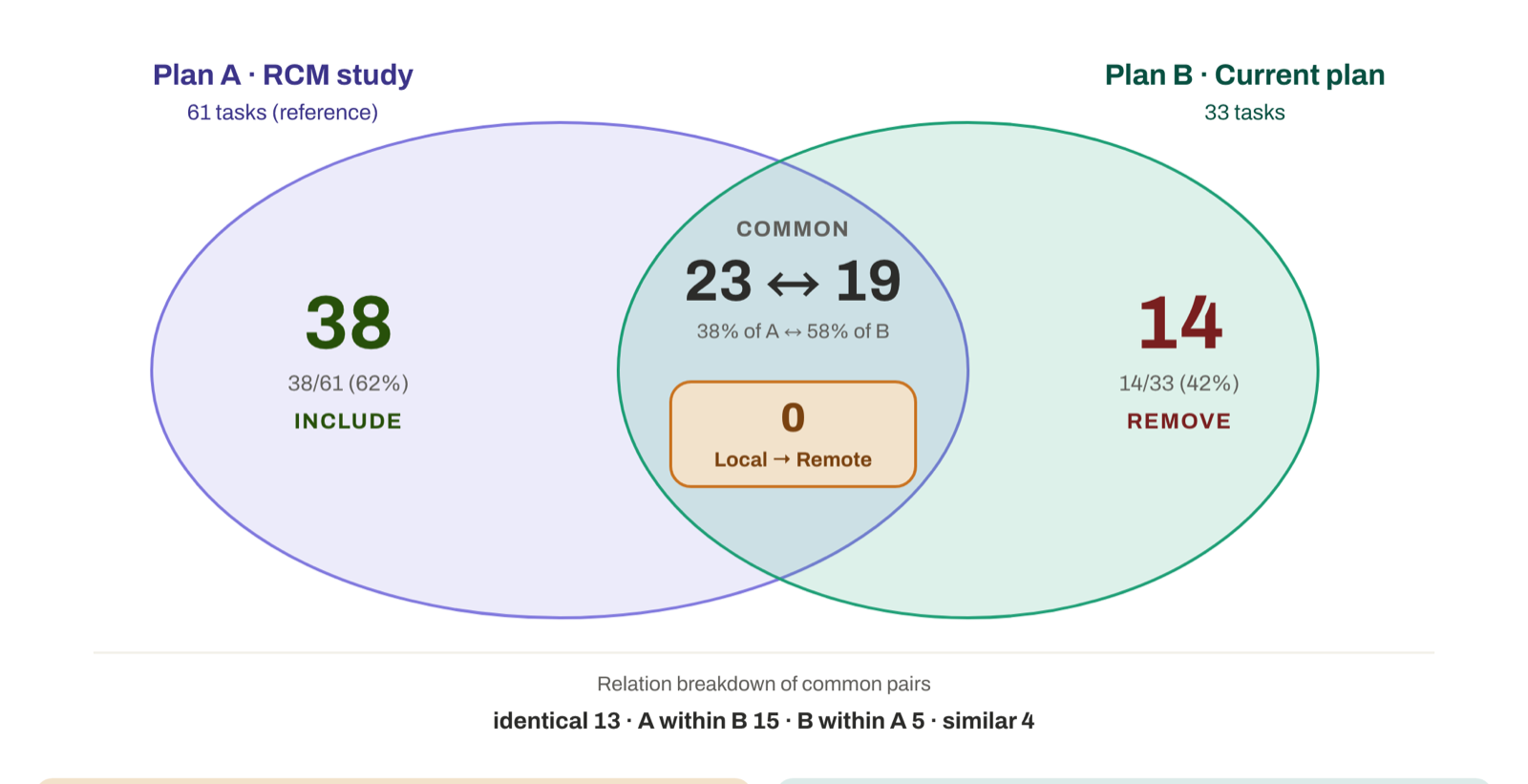
61 proposed tasks compared with 33 in the current plan. The results make the differences explicit for technical decisions.

38tasks to add
23 ↔ 19tasks in common across the two plans
14candidates for removal

Matches may link more than one task from each plan. The counts of 23 and 19 therefore do not represent one-to-one matches. Removals require validation.

View the actual comparison screenshot
Actual screenshot: RCM plan with 61 tasks and current plan with 33; 38 to add, 14 to remove, and 23 versus 19 in common.
Original product screenshot, with its interface language preserved. “Remove” identifies candidates for removal, not automatic authorization to discontinue tasks.

In another real case, 73 tasks were compared with 57 tasks in the current plan.

OPTIMUS MAINTENANCE / REAL CASE

The optimal shutdown considers
the full set of tasks.

Assessing each task in isolation and planning a combined shutdown lead to different decisions.

Individual assessment

12 of 14 tasks
1,039–1,040 weeks
1 task
48 weeks
1 task
137 weeks

The 12 tasks were not cost-effective in isolation in this case.

Optimal system shutdown interval39 weeks

The result of assessing tasks together, accounting for economies of scale. This does not mean performing every task at every shutdown.

Total annual cost

Cost of the combined tasks
Total annual cost curve redrawn from the actual report: the lowest cost occurs at an interval of 39 weeks, with costs rising at shorter or longer intervals.
39 weeks: the lowest-cost shutdown interval in this case.

Curves redrawn from charts in actual reports, preserving their results. Cases anonymized, without disclosing the calculation method.

For those accountable
for plant reliability.

Reliability engineers, maintenance coordinators and managers. Technical evidence for discussions with operations; clear scope and deliverables for procurement.

MiningSteelPulp and paperSugar and bioenergy

APPLIED RELIABILITY CO. · SINCE 2019

Let's discuss
your plan.

Tell us what you need to solve. We start with your assets' operating context, the available documentation and the results you need to deliver.

contato@appliedreliability.com.br

Brazilian industrial maintenance and reliability consultancy.

The button opens your email app with a message ready for you to review and send.

Before
you start.

Is the plan specific to our equipment?

The client's operating context and technical documentation guide the study. Functions, failure modes and tasks are developed for the assets defined in the scope and undergo human validation.

What is the difference between 1h 30m and 1–2 weeks?

Approximately 1h 30m is the processing time to prepare one case for review, as reported by ARC and not independently measured. The indicative 1–2 weeks refers to service delivery, subject to scope, documentation and the validation schedule. These are not equivalent time frames.

How much time does my team need to commit?

Your team provides references, clarifies the operating context and validates decisions. The schedule is agreed as part of the scope. There is no fixed number of hours that applies to every study.

Does advanced technology change the method?

The method remains RCM, following SAE JA1011/JA1012. Technology supports study development and the organization of references. Specialists validate the results. Reference to these standards does not imply that ARC is certified.

Can a task identified for removal be discontinued immediately?

No. The comparison identifies differences for review. Removal requires an assessment of consequences, applicable obligations and the client's technical validation.

Is running to failure also part of the study?

Yes, when it is the selected policy for a failure mode. The decision and its rationale remain traceable, subject to assessment of consequences and technical validation.

Which documents are needed?

Manuals, datasheets, drawings, specifications, current plans and maintenance history are useful references. ARC assesses the available material and agrees with the client on the information required for the scope.

Do we need to purchase all five products?

The engagement is defined by the problem and the deliverables required. The five products form the ecosystem that supports our services. Knowledge Base is shared infrastructure and is not sold separately.

How is the price determined?

The proposal takes into account the assets, extent of the study, available documentation and services involved. The initial technical discussion helps define the scope and prepare a commercial proposal.